

ISCO council member Ed Levine recently witnessed testing of a new type of boom at OHMSETT and kindly alerted us to this story.
By Tim Nedwed and Michel Boufadel
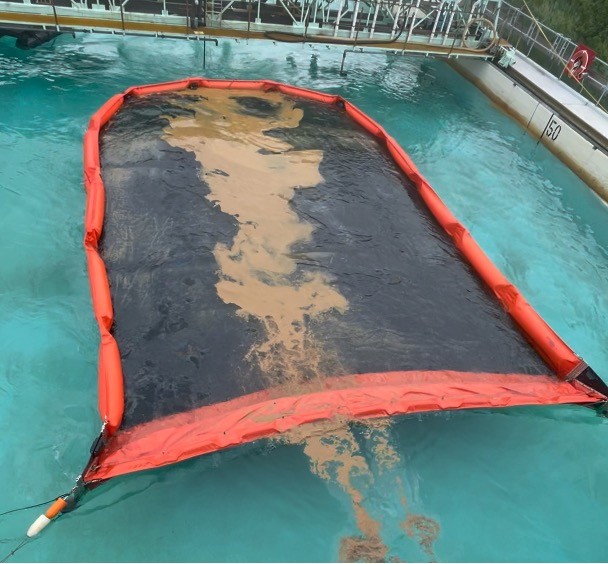
Recent testing at the OHMSETT National Oil Spill Response Research & Renewable Energy Test Facility demonstrated a new oil containment and recovery technology known as the TurboBoom™, a patent-pending system designed to overcome the speed limitations of conventional containment booms.
During a week of testing, a 1/3–1/2 scale TurboBoom prototype successfully captured all released low-viscosity test oil while being towed at 2 knots (1.0 m/s), with no observable entrainment losses. By comparison, previous OHMSETT testing of the same size conventional U-boom using the same oil showed entrainment beginning at approximately 0.75 knots, with catastrophic failure and extreme oil loss occurring at approximately 1 knot.
The TurboBoom operates using a familiar U-boom configuration but incorporates proprietary design features intended to eliminate all oil loss mechanisms that limit the performance of conventional containment systems. Test results indicate that the technology can enable effective oil collection at speeds significantly higher than those achievable with traditional U-booms. Based on current testing and analysis, the developers predict operational speeds exceeding 3 knots with minor modifications – at least 4 times faster than a conventional U boom.
Development of the TurboBoom began during the COVID period (2020) as a collaborative effort between LGM LLC and Parker Systems Inc. The program has involved more than 5 years of computational fluid dynamics (CFD) modeling combined with over two years of testing at OHMSETT. The prototype evaluated during the recent tests was the seventh design iteration and consisted of a 100-foot U-boom with a 30-foot swath width operating in approximately 1–2 foot steep wave conditions.
A key advantage of the technology is its scalability because the design can be adapted for applications ranging from rivers and inland waterways to large offshore spills. Unlike many commercially available fast-current booms, which have reduced swath widths, the TurboBoom is designed to maintain a large swath while operating at elevated towing speeds. A large offshore version of the TurboBoom is capable of encountering and recovering oil at rates several times greater than those achievable with the largest commercially available fast-current boom systems.
The technology may be particularly valuable for inland spills in rivers and other high-current environments. The TurboBoom is deployed and operated much like a conventional U-boom while enabling direct oil recovery in currents that exceed the practical operating limits of conventional containment systems. This capability has the potential to provide a step-change improvement in river spill response by increasing recovery rates, reducing downstream oil migration, and expanding the range of conditions under which mechanical recovery can be effectively employed.
In addition to increasing the encounter rate, the TurboBoom design provides substantial temporary oil storage capacity within the collection zone itself. For the prototype tested at OHMSETT, an average oil depth of 12 inches within the collection area corresponds to approximately 9,400 gallons (223 barrels) of temporary storage. This storage volume exceeds that of large commercially available high-speed recovery systems and provides operational flexibility by allowing significant quantities of oil to accumulate before skimming and transfer to dedicated storage systems. Because the TurboBoom™ is scalable, a full-scale ocean-capable system could temporarily contain many times more oil than the prototype tested at OHMSETT.
Current testing is focusing on higher towing speeds after optimization of key design components. This novel technology offers a new approach to improving mechanical recovery effectiveness for both inland and offshore oil spill response operations.
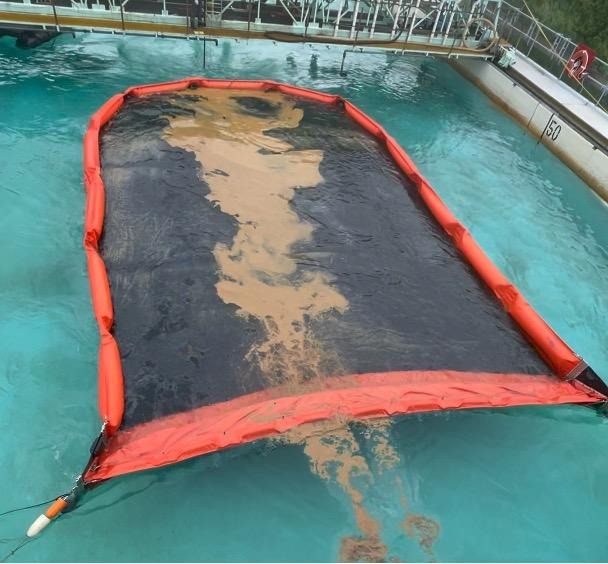
Figure 1. TurboBoom prototype undergoing testing at the OHMSETT facility during recent high-speed containment and recovery trials.
During the week of June 15, 2026, Ed Levine (SS&C, LLC & ISCO) was among several invited guests to observe and provide feedback on the testing of the patent-pending TurboBoom™ at the OHMSETT test tank facility in Leonardo, New Jersey. Several tows of the TurboBoom™ through the tank demonstrated its ability to contain oil while being towed at speeds up to 2 knots. While the tank tows showcased the TurboBoom™’s stability in waves up to 2 feet, the designers and manufacturer are actively seeking to enhance its performance to achieve a 3-knot tow. Following the observation of the test tows and discussions with the designers, several options for improvements were identified. These enhancing modifications will be incorporated, and further testing will be conducted to validate the proof-of-concept improvements to the design. In summary, the TurboBoom™ is proving to be a cutting-edge product for oil spill response and recovery.